Welcome to our 41st season! We’re honored to share artistic affiliate Tania Richard’s tour-de-force world premiere solo show. The strength of Tania’s memoir combined with her incredible performance abilities led us to commission and develop this adaptation Black Girl from a White Suburb for stage. American Blues Theater commits to telling stories about the American identity, particularly those who’ve been marginalized or disenfranchised.
Chicago Public Schools (CPS) announced on August 31, 2026, that they won their lawsuit against the U.S. Department of Education for withholding millions in federal funds due to the City’s Black Student Success Plan. This initiative aims to cut out-of-school suspensions, improve graduation rates, and increase the hiring and retention of Black teachers. Now that funding has been secured, one hopes CPS enacts this transformative plan to reduce the racial disparity in Chicago’s schools. On Sept 3, 2026, the White House announced further legal actions to dissolve non-profit status against institutions of higher learning who engage in any equity, diversity, or inclusion programs or studies.
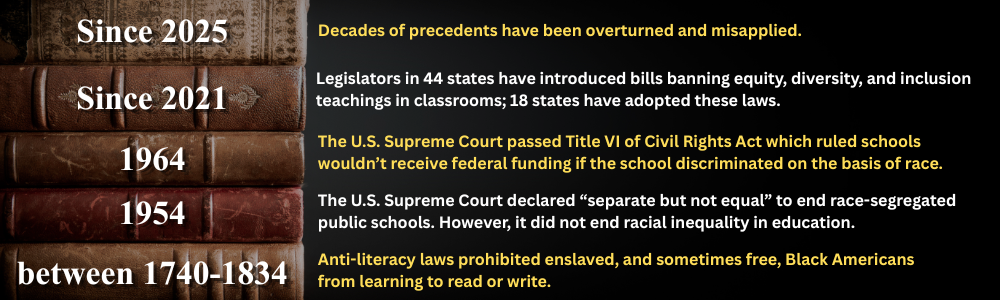
Make no mistake – the U.S. education system has always been unequal.
People agree that factors like location, wealth, teacher training, and quality of the curriculum influences a student’s success. However, there’s a large swath of folks that ignore additional factors like race, ethnicity, sexual and gender identities, religion, special needs, immigration, access to food & health, housing status, and safety. Research have shown these dynamics are more consequential to a student’s achievements.
So, what’s a parent to do – move into a *good* school district? As you’ll hear from Tania Richard, a *good* school district does not equate with acceptable care and instruction for all students.
Recently, I reread Martin Luther King Jr.’s opinion of the Brown v Board of Education decision. Reverend King said:
“I favor integration on buses and in all areas of public accommodation and travel…I am for equality. However, I think integration in our public schools is different. In that setting, you are dealing with one of the most important assets of an individual – the mind. A large percentage of [white people] have a very low opinion of our race. People with such a low view of the black race cannot be given free rein and put in charge of the intellectual care and development of our boys and girls.”
Reverend King understood and predicted generational damage to Black children if the basis of the white-centered education system did not change. It’s been over 70 years since the landmark decision, and it’s clear we have so much more work to do.
– Gwendolyn Whiteside
.